
(crossposted at PBDB)
Outlier: a data point that falls far from most other points; a score extremely divergent from the other measures of a set.
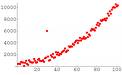
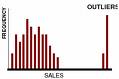
I first became familiar with the concept of “outliers” when my brother came home from his new job wearing T-shirt of the company softball team – it was their team name! (This job was at a DC policy think tank so I suspect that a fairly high nerd factor went into the name choice…) The term is a basic one in the study of statistics, and is based around a core phenomenon when one takes any kind of survey, or does a scientific experiment, or simply collects data of any kind on a large group of people. A classic example comes from sports judging. In sports like diving or skating, where the competitors are scored by a panel of judges, the highest and lowest scores are usually thrown out. Why? Well, what if the scores happened to be : [7,8,8,6,1,9,6]? The average of these scores is 6.28. But if I eliminate the highest and lowest scores, the average is 7, which is within one point of the scores of all the remaining judges. In this case, the low score in particular is a classic outlier example – it throws off our ability to see the opinion of the majority of the group.
Alright, enough with the math lessons… What the heck does this have to do with bass playing? Well, in a way our study of music and our growth as players is a huge, life-long research project. We are all observing and studying the playing of everyone around us in search of the best and most appealing ways to make great music on our instruments. As we encounter a great musician, we listen to and imitate the elements of their playing that appeal to us. Most good players share many similarities in their playing. The way the position the instrument relative to their bodies, the way they use the bow, and the way they position the instrument relative to their bodies, the way they use the bow, and the way they move their left hand are often similar. This isn’t to say that there aren’t a lot of different ways to play the bass well! Still, I’ve studied with and learned from many talented players whom I respect highly, and I’ve heard almost all of them say similar things about the basics of good playing. The differences between them are usually much more subtle than the points of agreement.
However, I’ve also encountered the occasional outlier as I’ve heard and seen bassists over the years. They seem to be doing everything differently than most players I see. Maybe they hold the bass in a very unusual way. Maybe they use very atypical fingerings. Maybe they seem to have more tension in their body than do many talented players. Yet, despite these unusual characteristics, they sound good or even great. Sometimes this is in spite of their unusual technique, or sometimes it may even be because of it. The point is that their unusual technique works for them.
I emphasize those two words for a reason: We all need to remember that the techniques of outlier players will probably not work well for most people! Sometimes these techniques are not even the most effective for the outlier player; they may simply have the innate ability or personal drive to play well despite them. Or they may have unusual physical characteristics that require unusual technique. Or their brain may simply function differently than most folks. Sometimes outliers are actually visionaries. Their unusual playing choices end up working better for so many people that they actually become the “new normal,” displacing older ideas to some extent. I’m old enough to remember the how unusual many of the techniques of Francois Rabbath once were to most bassists.
Things start to get tricky for students when their own teacher is an outlier in some respect and lacks the self-awareness or training to understand this. The student can end up learning a technique that only works for a small number of players, yet they may be led to believe that this is the preferable or the only way to approach a certain playing issue. I have seen players struggle with their playing for years as they try to master a way of playing that simply isn’t effective, yet seem unable to acknowledge that they need to find another approach.
In my next post, I’ll consider ways that students and teachers can deal with being an outlier or learning from one…
Bass News Right To Your Inbox!
Subscribe to get our weekly newsletter covering the double bass world.
Great article! I’ve always been a nerd for statistics, and I love the way you explained this concept.