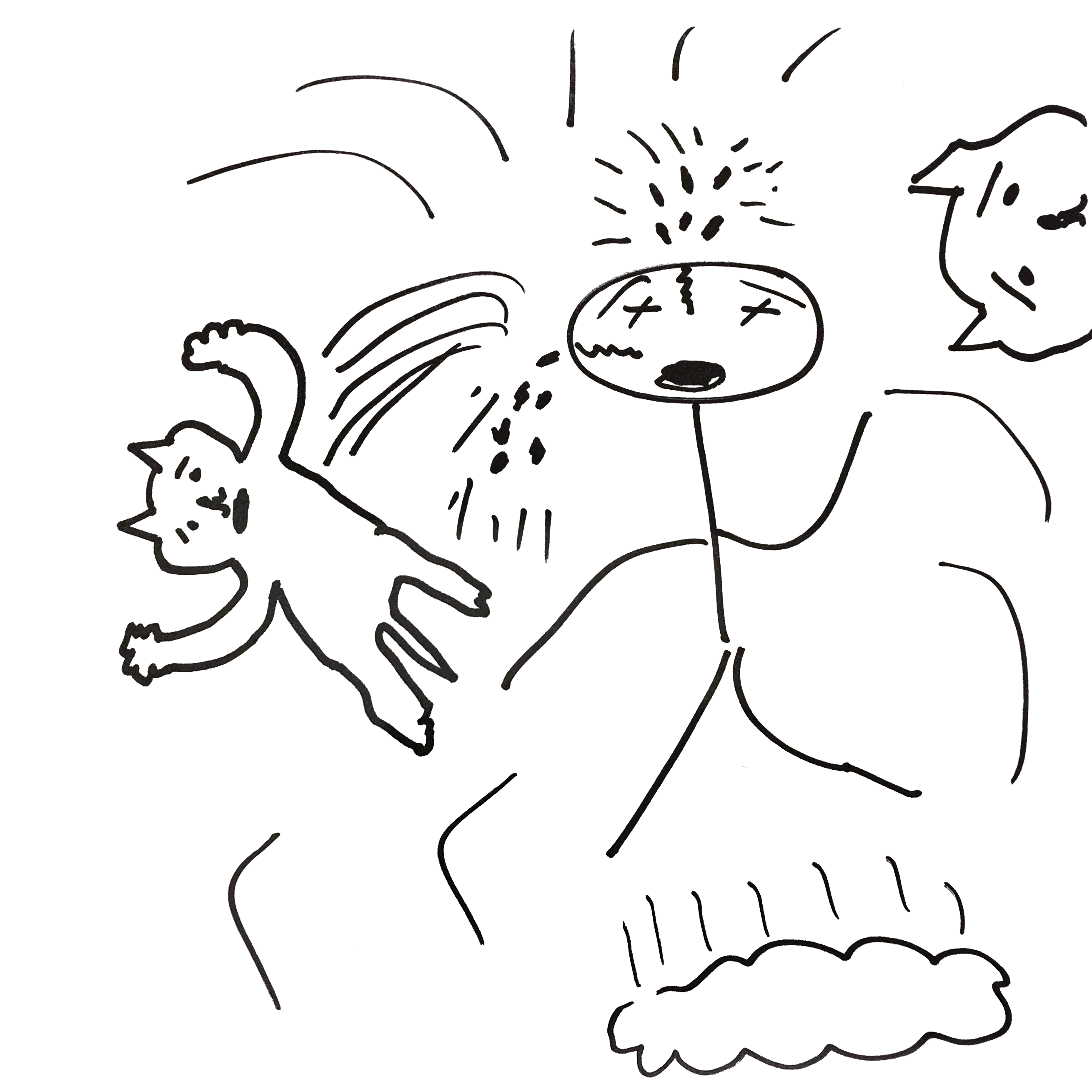
You want me to play…. with those?
Jason’s wife, Courtney, here. Though I’m not a bassist, I do play a
large instrument (the harp, whose lowest note is the same C as a bass’
with a C extension), and as such I feel an affinity for my bass-
playing bretheren and hope you’ll indulge me in a guest post.
As a professional harpist since 2001, I’ve played my share of normal,
everyday gigs that most other freelance instrumentalists have had
experience with. I’ve played with dozens of orchestras, from the
community orchestra down the street to the Chicago Symphony Orchestra.
I’ve played hundreds of weddings and nearly as many cocktail party-
type gatherings.

Over the years, unfamiliar situations that once made me nervous have
become routine, and I have developed a distinct mental blueprint for
efficiently executing the various gig types I encounter. For example,
my mental map of a typical cocktail party: load harp in car. Drive to
swanky venue using trusty GPS. Park as close as possible, especially
if in a snowstorm. Unload harp and wheel it into the venue, digging a
path through the snow if necessary. Pretend like it’s the first time
you ever heard the joke, “Bet you wish you played the (insert small
instrument here)!” even though at least one person says it to you
every single time you move your harp from one place to another.
Endeavor to keep your head from exploding when one more person looks
at the huge harp, which towers over your 5′10″ body, and asks you,
“Hey! Is that a cello???” Find a mirror and make sure all of this fuss
didn’t mess up your hair or otherwise make you look unfit to play a
swanky party. Meet and endear yourself to the client and the catering
coordinator or event planner. Tune harp. Set up stand… Realize you
forgot stand in car while trying to keep your head from exploding when
passerby asked if your harp was a cello. Go back for stand.
Eventually… Play. Have fun. Chat with random and always-interesting
people on breaks. Etc. Okay, it’s not always a perfect blueprint, but
what I’m trying to say is that I generally know what to expect when
I’m on the job.
But my harp playing career has also brought me some rather out-of-the-
ordinary experiences. One summer day a few years ago, I had such an
experience. A call came in from a casting agency, saying that they had
found my website and were wondering if I wanted to come downtown and
audition to be in a commercial. Having zero experience with such
things at the time, I was thrown off. “Uh, well – I mean, sure, but
I’m not, like, an actor or anything,” I stammered. No, no, the man
said, this was an audition to play harp in a commercial, and he was
inviting about 20 other harpists from around town. Now I was back on
solid ground. “oh, a MUSIC audition. Yes, sign me up.”
The next day I was sitting in the casting agency’s office in a row of
other artsy-looking harpists seated along one wall. I learned that we
were auditioning for a commercial for Totes, which I vaguely recalled
as a brand of slippers, umbrellas, and maybe gloves. There must have
been another audition going on for a role called “Skinny Woman” or
“Woman with Pelvis-to-Head Ratio of Less Than 1,” because a row of
impossibly thin and far more fashionable ladies were seated along the
opposite wall.
The agency had rented a harp for the audition, and the paper-thin
walls in the trendy loft that housed the agency permitted each
harpist’s audition to come through loud and clear into the waiting
room. A harpist would be called in, and within moments we would hear a
blazingly confident, supremely professional rendition of a standard
harp excerpt or solo – we were told we could play whatever we wanted.
And this is when things started to become a bit unusual. Following
this performance, we would then hear a long series of muffled,
cacophonous harp sounds that are hard to describe directly. Rather,
I’ll liken it to an actor who has just performed a famous Shakespeare
monologue and then tries to repeat the same monologue, but this time
his mouth is stuffed full of cotton balls and the casting director is
trying hard to strangle him as he speaks. The harpist would then come
back to the waiting room to retrieve her things, face red and eyes
cast down to the floor, and hurry out before we could find out what
had happened. Every audition before me went this way, and I was
supremely uncertain of what was going to happen when I got called in
to the audition room.
Masking my nerves with a smile so wide my face hurt, I breezed into
the room and exchanged pleasantries with the casting director and
others in the room. I sat at the harp and played a piece I figured
people unfamiliar with the harp would like – one filled with
glissandos and other fun, flashy things that let me kind of ham it up
physically. This was an audition to play on camera, after all – I
figured that how it looked was at least as important as how it sounded
in the commercial milieu.
The casting director cut me off after a generous amount of time.
“Okay, that was really great. Now, I need you to play that again…
While wearing THESE.” And he proffered a pair of bright-red leather
gloves.

Mystery solved.
“Ah. Okay. You know, you… Can’t really play the harp with gloves
on,” I protested as politely as I could.
“Yes, so it seems,” replied the casting director, “But I need you to
TRY.”
Shrugging, I donned the gloves – rather loose and clumsy-feeling on my
bony fingers – and dove back into my solo with all the charisma I
could muster. Luckily, glissandos sound pretty darn good even with
gloves on. The bulk of the piece didn’t sound so great, but I left my
pride behind and just tried to have fun and look as graceful as
possible.
The director cut me off, promising a call the next day, and I returned
to the waiting room. The remaining harpists looked at me expectantly.
I walked to the exit and opened the door. Just before slipping out, I
turned and said, “You have to wear gloves.” The room burst into
conversation as I got out of there.
I actually ended up getting a callback audition and was subsequently
cast as the harpist in this commercial for Isotoner Gloves (made by
Totes). They ended up recording the harp separately (thank
goodness!!), then playing the track back as I faked playing the piece.
In addition to a cool experience on a set and getting to feel
glamorous with wardrobe, hair, and makeup, I got a great paycheck and
a sweet pair of leather gloves that had been perfectly tailored to my
fingers in order to look good in close-up shots. Unfortunately, I
eventually lost those gloves – probably in a moment of distraction on
a subsequent gig as I tried to remain polite when the thousandth
passerby asked me if I wish I’d played the piccolo.
A professional harpist for many years, Courtney currently works in a research lab and will be starting medical school at The University of Chicago’s Pritzker School of Medicine in August 2010.

Boredom and terror in the recording studio
Most of the time I get called for straight-laced classical fare, usually consisting of endless half notes and whole notes. My chief concerns in these cases usually end up being things like making sure I don’t cough or drop my bow as I go completely mentally vacant with boredom.
What the hey?!?
I was playing bass for one one these aforementioned whole-note sessions, flipping each chart over as we wrapped it up and thinking about my various dinner options.
I flipped the next chart in the stack, and my heart took a sudden leap into my throat. The music I was about to sight-read for this session was absolutely covered in black, with sixteenth notes buzzing up and down the staff, intricate hemiolas and rest patterns, and tons of tricky accidentals all over the page.
Crap!

How could I have missed this one when I was flipping through my music at the beginning of the session? And what on Earth was a nutso chart like this doing in my stack of easy-as-pie first position whole note tunes?
With no time to think (the engineer was ready and waiting for our small string group to start behind the glass), I picked up my bow, knowing that I was about to embark on one heck of a sight-reading adventure.
Click, click, click…
We were off and running, and I was bobbing and dipping like a maniac, navigating these off-the-wall sixteenth note passages as best I could. Out of the corner of my eye, I noticed that all of my upper-string colleagues were watching me with bemused grins. Their parts were half-note and whole note chords, just like all the others, and I soon realized that this track (for Christmas album, of all things!) was arranged as one bizarre bass solo.
Fortunately, I’m a pretty good sight-reader, and I started to gain confidence as I realized that there would be no respite for me through the entire track. I jammed out as well as I possibly could given the circumstances, and was feeling pretty darned proud of myself as the other string players played the final chords of the arrangement.
As silence filled the studio, I shook out my arms and waited to see what the engineer wanted to punch in. After all, I did a good job, didn’t I? Maybe just few bars here or there to clean up?
Long silence.
My confidence wavered.
Finally, the studio speakers came on:
“Um… Jason. Can I see that bass part?”
I snaked my way through the cables and mic stands, meeting him at the door.
“Jason,” he said, “that’s the electric bass part.”
Apparently, the bass guitar part had been misfiled in my folder. The string tracks were just sonic padding on this record, and the electric people would be in a few days later to lay down the groovier stuff.
Blushing profusely (though it wasn’t really my fault, was it?) as my actual part was handed to me, I took my seat again, and we took it from the top, with my actual part being even simpler than the other tracks. I only played a few pizzicati and a couple of whole notes, in fact.
So much for my rockin’ Christmas solo upright bowed solo jam track!
How to play a bad audition
One of my all-time favorite audition stories came from a member of a major symphony when I asked him what the worst audition he’d ever heard was like:
Apparently, this orchestra never pre-screens their candidates, making for a quite egalitarian yet massively populated pool of candidates. Due to this policy, there are at least a handful of auditionees that have the panel rolling on the floor (figuratively, at least) in suppressed laughter or else slouched in their chairs with tears of pain rolling down their cheeks.
The double bass always attracts a motley crew of candidates anyway, and having no screening process usually means that there are some real characters stepping up on stage to strut their stuff. While painful to the ears of the long-suffering committee, it can also provide for some much-needed levity after hour after interminable hour of nervously executed symphonic snippets.

One such bass player entered for his audition (behind a screen, of course) and started tuning extremely loudly, roaring away on his low strings in an apparently futile attempt to get in tune. Not a good sign.
The committee was fidgeting away while waiting for the candidate to begin, only to slowly realize that, in fact, the candidate had begun, and that these crass attempts at tuning had somehow morphed into the first movement of the Vivaldi Sonata No. 3 for Cello, played as low as possible in the fist position of the bass. The candidate clacked and rattled his way through the first few phrases of this piece, grinding his low strings like some sort of lower life form, with the committee looking at each other with some amusement.
This audition was going to be fun.
The committee cut off the “grinder” after a bit, asking him to play the final movement of Mozart’s Symphony No. 40, a tricky excerpt that requires quite a bit of agility on the part of the player. Not easy even for a top-caliber player, so how would this fellow fare.
Long pause.
The first four notes came out, a confused jumble of crud, then nothing.
Long pause.
Another attempt at those first four notes.
Silence.
Finally (and with much hysterically silent laughter from the committee), this fellow burped and snorted his way through this excerpt, like a piano falling down a set of stairs, only less graceful.
Having fun now, the committee proceeded to ask the candidate to play rehearsal number 9 from Ein Heldenleben, an even more fiendishly difficult passage for string bass.
Longer pause.
Finally, the proctor (the person with the candidate who points out what excerpts to play and helps coordinate the audition facilitation) calls out from the candidate’s side of the screen:
Proctor: Uh… the candidate declines to play this excerpt…
Committee: OK–thank you!
Don’t you just love bass auditions?
Can basses actually fall like dominos?
An unfortunate thing happened at one of the exhibitor displays during this year’s International Society of Bassists Convention. This is the kind of horror movie episode that is sure to give both bassists and luthiers nightmares…
One of the shops exhibiting basses was using a classy kind of bass stand–wooden and elegant, something like the following:

Now, these racks are attractive, but as you can see from the photo above, they don’t provide a whole lot of stability for the instrument. In this scenario, each bass is resting in a shallow indentation, with nothing else supporting it.
Apparently (and I wasn’t there to see this, but word traveled fast across the convention floor after the incident!), one of the parents of a young bassist was putting a bass back that they were trying out. They put it back in the rack and must have gotten it off-center. As they let it go, the bass tipped over.
Now, this is bad enough on its own, but this was but one bass in a long line of basses, all in similar racks. The off-kilter bass smacked into the bass just to the side of it, knocking it over as well, thereby setting in motion the world’s most expensive set of dominos:

Can you imagine the utter shock and horror on everybody’s part: parent, shop owner, and conventioneers? Each bass clobbered the one right next to it, damaging (to greater or lesser degrees) the bass next to it, which in turn fell over, damaging the one next to it. Yikes! I still wake up dreaming about this… and I wasn’t even there to witness it!
Dramatic Double Bass Destructions

I was sharing stories of horrific double bass destructions with the students in the low string methods class I was teaching at DePaul this past spring, and I realized that I actually had two tales (not about me, luckily!) that I hadn’t yet shared on the blog:
Look Behind You!
One of my students was getting all packed up and ready to do to youth orchestra rehearsal. He took his bass outside and set it down, heading back inside for some reason or another. Unfortunately, he had set it down behind the van that his mom would be driving, and while he was away from the bass, his mom popped the car into reverse and backed out of the garage, squishing his bass in the process. That must have been a horrific feeling for both parent and bass player!
Squished by the Set
Another former student of mine was playing bass for his high school’s variety show. He had his bass stored backstage (just like I’ve done for countless shows). A big piece of the set toppled over at some point during the show, landing right on top of his bass and flattening it.
Both of these students actually ended up with much better basses than the (now squished) ones they had been using. I suppose that’s one way (certainly a dramatic way) to get the ball rolling on a new instrument!
Has this (or something like it) ever happened to you?