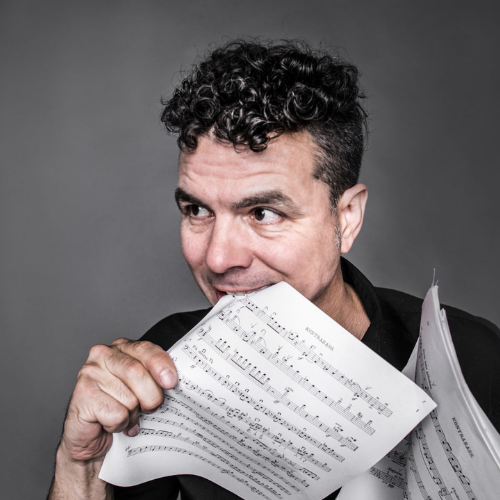
Jeff Bradetich’s new book (video)


University of North Texas and Cleveland Institute of Music bass professor Jeff Bradetich (also a former Contrabass Conversations guest) has just released a book titled Double Bass: The Ultimate Challenge . This book represents the culmination of all the concepts and techniques Jeff has explored while working with countless students over the course of his illustrious teaching career.

As you can see from the following video this is also a beautiful book, with each detail given meticulous consideration. It’s nice to see a pedagogical text for the bass that doesn’t look like it was produced in 1885!

Here’s the press release for the book:

Music For All To Hear, Inc. announces the publishing of Jeff Bradetich’s eagerly awaited book on Double Bass Pedagogy and Performance. This highly anticipated text has been received by the Double Bass community with open arms and sold hundreds of copies, strictly by word of mouth, at the 2009 International Society of Bassists convention recently held at Penn State University.

Here is what a few well respected bassists have had to say:

“Students from all over the world and from every level, please, trust him! Take everything as your real basis for a well- founded technique! I personally, and totally, agree with the content.”

Thierry Barbe – Principal Double Bass Opera de Paris National Orchestra

“Jeff Bradetich is a world-class virtuoso performer and passionate teacher who has acquired enormous depth and
experience to author such a masterful text.”

Rufus Reid – The Evolving Bassist

“This is one of the most important books of the last fifty years. It should be in every university and conservatory library,
every teacher of the double bass should read it, and double bassists of every level will find confirmation of their strengths
and lots of answers for their questions.”

Orin O’Brien – New York Philharmonic

Double Bass: The Ultimate Challenge © 2009, Music For All To Hear, Inc. — ISBN-13: 978-0-615-29665-4 — is published by, and available immediately from, Music for All To Hear MSRP: $59.95.

For orders, visit the website http://www.musicforalltohear.com/cart, contact Aaron Bradetich at aaronb@musicforalltohear.com, or call 940-367-2360. Music For All To Hear, Inc. is the record label of choice for Jeff Bradetich and also specializes in the publishing of many artists’ CD’s, DVD’s, sheet music, and books.

CBC 122: Music School Choices

 
icon for podpress  Standard Podcast: Play Now | Play in Popup | Download

The number of considerations a prospective music school student faces these days can be quite staggering–in this week’s episode, I try to give listeners a summary of the most important considerations in the quest for the ideal music school. Enjoy!

Hans Jørgen Jensen cello master class video

As the podcast coordinator for the Midwest Young Artists program here in metro Chicago, I have to opportunity to pore through some very cool videos, some of which I also like to share here on doublebassblog.org. This video (approx. 25 minutes) is of a master class given by Hans Jørgen Jensen, Northwestern University’s cello professor and one of the most outstanding string teachers I’ve worked with. Though more of a group class than a true “master class,” this session touches upon string technique and practicing concepts that I think bassists will find illuminating:

Private Lesson Studio Ruminations – complete multi-part series

I’ve done several multi-part blog posts over the years, though my output has admittedly slowed somewhat since getting bogged down in school this past year. Most of these posts are gig stories, however–I think that this is my first one dedicated solely to music/education. As a person who teaches a lot of private lessons (and has done so for quite some time), this series reflects topics and issues that I chew on mentally all the time:

Part 1 – Chicken or Egg?

Part 2 – Faculty Affiliation or Private?

Part 3 – What I Teach

Part 4 – The Path to Music School

Part 5 – Different Styles for Different Students

Part 6 – Complacency

Where should I go to school?

A Contrabass Conversations listener who is starting college this fall wrote in recently with a question that most people are likely to wrestle with when going to music school: when deciding between two schools, should you go with the cheaper but less prestigious college, or the more expensive but more prestigious option?

Now, this is certainly not a decision faced solely by music students, but there are certain musician-specific factors that might influence your decision in different ways than if you were considering a business, engineering, or traditional liberal arts degree.school choice.png

In my post titled Top Ten Ways That College Debt Screws Up Your Life (June 2008), I wrote the following:

A recent article in the Chicago Tribune (May 28, 2008) reignited some long-standing concerns that I’ve had for a longtime about the massive amount of educational debt many musicians accrue during their years of training. This trend is affecting all college students (not only musicians), but since our earnings tend to be rather meager compared to other professions requiring high-dollar degrees, this trend is especially alarming for future music performers.

Achieving success in the classical music world (I’m defining success rather narrowly here) often requires a musician to audition for a select handful of schools that have a specific teacher on faculty with a reputation for turning out “successful” students. Unlike disciplines like engineering, business, or computer science, there are frequently only a few schools that have a consistent track record of placement for a specific instrument. Want a job? You’d better think seriously about fighting for a spot at one of those schools… even if that school costs $40,000 (or more) plus room and board each year.

After spending $200,000 (or $300,000, or more!) on that undergraduate education, you may very well find yourself in the orchestral trenches battling for that job with a meager $20,000 to $30,000 salary, spending another $1000-2000 a pop on dozens of auditions (several of my older colleagues have taken 80, 90, or even 100 auditions before landing a position, and some still never landed a job).

The complete post offers more reflections on some of the drawbacks to being saddled with massive college debt, but let’s take a look at this particular student’s specific situation and see what option might be most advisable in this case:

Good versus Really Good

This student was deciding between a school that would cost around $20,000 a year and a school that would cost around $50,000 a year (including room and board in both cases). Both of these school have established track records at turning out bass students that are competitive on the audition scene, and both have teachers that are considered among the best in the business.

The more expensive school was the student’s preferred choice discounting cost for a number of reasons: the teacher he’d be studying with was his number one choice for bass teacher, hands-down; it is in a more exciting city with a bustling and vibrant music scene; the reputation of the music school as a whole is stronger. On the other hand, both schools have excellent bass programs and quality music programs, even if the more expensive option is a little more attractive overall.

If we discount cost, then, the more expensive school is a more attractive option. But look at the difference in cost! For the cheaper school, a four-year program would saddle the student (and his parents) with $80,000 in college debt, while the more expensive school would end up costing $200,000 for the same amount of time. That’s a tremendous difference.

Take a moment and think about the difference between being $80,000 in the whole and $200,000 in the whole. Granted, both values make me want to jump off a cliff, but we’re talking about a truly massive difference in price. Then factor in the interest on these two values, and this student would be looking a a student loan payment that may well prove completely unmanageable on his likely earnings.

While the desire to study with your number one choice is a powerful factor in this decision, I’m not sure if the benefits outweigh the drawbacks in this case. Is there another option to work with this teacher outside the school structure? Does this teacher serve on the faculty of any summer institutes, like Aspen or the Music Academy of the West? Could you arrange to take some private lessons with them? It’s not the same as actually studying with them for a degree, of course, but it may be a good compromise.

Final Thoughts

In many cases like this (and I am advising students about these tough decisions constantly), I tend, if the two options are both good but substantially different in cost, to advise that the student go with the cheaper option and then augment their college music study experience with summer festivals and additional lessons from teachers with varying viewpoints. Why not go with the cheaper option and then study at Aspen in the summer? Many of my colleagues credit Aspen with some of their most valuable learning experiences, even though they were also studying at Eastman, Juilliard, or the Cleveland Institute. With college costs where they are today and the earning potential of music school graduates shaky at best, this course of action seems ever wiser.

Success in the Private Lesson Studio Part 6: Complacency

This final installment in the Success in the Private Lesson Studio series addresses something that can easily happen to private teachers: complacency. After establishing a reputation as a teacher and building up a studio, many teachers start to look at private teaching as a somewhat lucrative but rather burdensome part-time job, something to be tolerated rather than enjoyed. Teachers can enter this state without even realizing it, slowly slipping into familiar patterns and becoming too easily satisfied with the results they are getting from students.

Many teachers, or course, never fall into this state of complacency. They continually reinvent themselves as teachers, broadening their horizons by performing as much as possible, attending concerts and conferences, reading avidly from a wide range of sources (both pertaining to their instrument and to education in general), and constantly asking themselves the following question:

“What if?”

What if, rather than giving students the Capuzzi Concerto, I swapped out a variety of short pieces in different ranges of the instrument? What if I taught pivoting from the beginning rather than Simandl technique? What if I introduced the bow in this new way I just read about? What if I approached intonation in a different way? What if I assigned different scale exercises?

If a teacher is teaching students headed for music school, are these students advancing toward the current professional standard for their instrument? What, exactly, is that standard right now? Is it different than when the teacher was in music school? If so, how? What is the best way to guide students toward that standard? And what if a student doesn’t seem to be responding to your methods? What can you vary? What is an alternate approach? Is there only one door leading to success, or are there many doors?

I think that as soon as a private music teacher decides that they have discovered the way to teach something, they have (usually and unwittingly) slipped into a state of complacency about that topic. To put it bluntly, the more smug and overconfident a teacher appears to be about their method of teaching, the worse they tend to be as an educator. The best teachers, on the other hand, are always broadening their musical horizons, and as a result their teaching methods are always evolving.

Continuing to grow as a teacher also means continuing to grow as a musician, and this is an easy thing to let atrophy as a private lesson teacher. It can be easy to forget that you are, above all, working with a student to help them develop a love for the art and craft of music, and guide them toward developing the skills necessary to achieve their fullest potential. A good teacher goes beyond assigning and evaluating materials and uses all their abilities to inspire and motivate students. This is, or course, true of all teachers–not just private music teachers–but it’s easy to lose sight of this during a long block of half-hour lessons with students.

Final Thoughts

This brief conclusion to Success in the Private Lesson Studio may seem like an obvious point, but I think that it bears contemplation anyway. The best teachers are curious and constantly learning themselves, flexible and adaptable. They are interested in continually broadening their horizons and expanding their “teacher toolkit,” and regularly reevaluate their approaches to the various aspects of their pedagogical approach.

Success in the Private Lesson Studio Part 5: Different Styles for Different Students

I’ve taught a wide array of students during the past 10 years as a private bass teacher. Some of them made me tear my hair out, some of them remain good friends and close contacts to this day, but all of them taught me something important, both about me as a teacher and about the different learning styles and levels of interest found between different students.students.png

By and large, the students I teach in a private lesson setting taking lessons because they want to take them (the other reason is that their parents are forcing them, but few of my students fall into that category these days). Though they may express it in different ways, these students honestly want to improve as musicians, and my job as teacher is to find the best approach for each individual.

Styles of Students

Everybody’s unique, of course (a point I’ve emphasized throughout this series), and therefore requires an individualized approach from the private teacher, but there are three general categories into which most students fall. These are categories generally start to manifest themselves in middle school, and students usually fall pretty clearly into one of these three categories by high school:

1. The “Music School-Bound” - These students are really gunning for it, working toward a career as a professional musician, and they therefore adhere most closely to the curricular list I outlined in part 3 of this series and will spend the last two years of high school going through the audition preparation activities described in part 4 of this series. To put it simply, these people listen to what you, the teacher, says and works diligently on perfecting their craft. Teachers wish that all their students fell into this category. They may or may not be actually end up going to music school, but they place a high priority on their musical development, and they end up practicing the most as a result. Students in this category usually (from me, at least) have lessons that end up resembling college-level lessons.

2. The “Plethora of Activities” Student - Students these days are often pulled in a dozen different directions, feeling pressure to achieve academically, play sports, participate in clubs, star in the school play, and do music all at the same time. They may love music, but they have many other interests as well, making practice time a challenge. Having diverse interests is a really good thing, and as high school progresses students usually settle on a fewer number of activities in which they really excel. Practice time is a challenge with students like this, and my focus as a teacher often turns into practice time management, focusing on a couple of clear concepts and outlining ways to fit in practice time where possible. Some of these students love music but simply don’t practice. The old saying “you can lead a horse to water, but you can’t make it drink” comes to mind with some of these students–no amount of pleading, cajoling, and stern admonition on my part has an affect aside from making them dread lessons. Now, there’s a fine line between empathy and being a pushover, and I try to be careful in this regard, but I sincerely believe that students can benefit from lessons even if they’re not practicing much if the focus of the lessons is shifted appropriately. Still, lessons are always more valuable and will lead to exponentially faster improvement if students regularly practice between them.

3. The Reluctant Learner - I have fewer and fewer of these private students with each passing year (I think, at least–maybe I’m deluding myself!), but most teachers working with pre-college instrumental students will work with people who are not taking lessons because they want to but because they are being made to, either by their parents or by their orchestra director. This doesn’t necessarily mean that they don’t like me or music, just that they’re not really that into taking lessons. And while I’ve found that students in this category frequently metamorphosize into one of the two previous categories, some students just don’t particularly want to be there. As a result, I generally have to be firmer with these students, setting concrete practice goals–they are not likely to work further into a piece out of musical curiosity, are less likely to practice, and may be less receptive to methods that work on the students that do want to be there. I always try to keep in mind that, even if a student isn’t their out of their own free will, I can still make the lesson an enjoyable experience for them, and that just because someone starts out not wanting to be there doesn’t mean that they won’t lear, over time, to enjoy their lessons (or aspects of their lessons, at the very least). After all, there have been innumerable activities in my life that I have not really wanted to do. Some I learned to love, some I learned to appreciate, and some I simply never enjoyed. Who knows what students will end up gravitating toward? I always try to keep an open mind with students, having seen so many people’s attitudes of indifference transform into enthusiasm over time.

Teaching Styles

These by no means are hard and fast categories; in fact, I rarely use only one of the following approaches, usually opting for two (or more) of the following styles. Keep in mind, also, that I typically teach high school bassists, with some middle schoolers mixed in as well. I don’t work with a whole lot of elementary school bassists. As a result, I tend to be less of a taskmaster and more of a mentor with the older students, and more of a taskmaster with the younger students. This is what works for me, but I’m sure that different teaching approaches:

1. Taskmaster - Some students need a lot of structure from their lesson teachers. If you don’t tell them to do it, they won’t do it. If you tell them to do it but don’t consistently check up on the previous week’s goals, holding them personally accountable for their practice, they won’t do it either. There is, of course, a bit of the taskmaster in every student/teacher relationship (otherwise you’re not really teaching, you’re just hanging out), with the expectation of some sort of consistent practice and improvement. With students that need to be held accountable for each step of their practicing, our lessons take on a fairly regimented format, with some sort of warm-up, followed by assessment of each of the practice goals for the previous week, the introduction of a new piece, section, or concept, and a few minutes at the end to write down each specific goal and how they will approach it. I may get as specific as (play this bar five times, then do this bar eight times), though I’m rarely this regimented with high school-age students, trying instead to encourage them how to analyze and solve problems on their own.

2. Problem-Solver - I often fall into a role of problem-solving facilitator with my older students, trying whenever possible to get students analyzing their own playing and get them thinking about how to solve problems. I think that I used to just tell people what to do a lot more when I started teaching. Now I tend to ask a lot of questions, explore different options, and (this is really useful) video record them on my laptop and watch it back with them, pausing when necessary to talk about what we’re hearing, what works and what doesn’t work, and how we can work on particular passages. There is, of course, going to be a lot of intermingling between these roles. A teacher who is 100% problem-solver is not likely to be very effective, since they will have no clear achievement standards for their students. At the same time, a teacher who is 100% taskmaster may have obedient students who dread every lesson, learning over time to hate music in general. I probably err too much on the problem-solver and mentor side of things, but that’s my style, and it seems to work for me.

3. Mentor - I feel that the responsibilities of a private lesson teacher extend beyond these isolated hour-long lessons, both in leading students toward youth music programs and summer camps, and also getting them excited about the art form in general and showing them what’s really great about music. I like to, whenever possible, get students excited about being a member of the double bass community, and I try to get them as enthusiastic about the art form as I am.

4. Practice Buddy – Sometimes students (generally younger students) need someone to actually walk through the entire practicing process with them. With some students (and this is not my favorite role, but it ends up being one I inhabit from time to time), I become like a human practice supplement, playing drone pitches, playing along an octave below, keeping time, making them loop passages over and over, and basically doing all the things that they should be doing during their own practice sessions. I fall into this role (though there’s a bit of this approach in nearly every student’s lesson) most often with people who don’t really practice. I try to both be an example for them, showing them what they should be doing during their practice sessions, and if someone is simply not working, I end up making the lesson an hour of highly supervised and guided practice. If they don’t practice at all, at least they get that one hour a week, though students that don’t work on their own typically end up becoming “former students” of mine in short order!

5. Organizer – Some students may be great problem-solvers and very enthusiastic, but are just disorganized in their approach to practicing and to the instrument. Helping them to keep a practice journal and helping them to figure out how much of each practice session should be devoted to a particular piece, etude or technical exercise can help them to get more efficient and useful practice sessions in. Unlike the “Practice Buddy” students, these students typically do want to work, but they haven’t figured out a very effective way to practice. I like helping people with this kind of structure–I’ve thought about how to best organize my practicing for countless hours–and most students that fall into this role move out of it after a short time and into one of the previously mentioned roles (though hopefully not #4!).

The complete series – Success in the Private Lesson Studio – This multi-part series details my thoughts, perspectives, and observations on what makes a good private lesson experience and how to best use this interaction as a springboard for future career success.

Part 1 – Chicken or Egg?

Part 2 – Faculty Affiliation or Private?

Part 3 – What I Teach

Part 4 – The Path to Music School

I’m on faculty… really!

Though it certainly had its drawbacks (did you know that if you Google “disturbing adjunct teaching,” this post of mine comes up? Ha!), I did enjoy having an institutional affiliation for my bass teaching for the five years I taught my university studio double bass. It was nice to be able to say that I was the bass teacher at the University of Wisconsin-Whitewater, rather than identifying myself as just some solo bass dude like I do now (though not in those exact words).

Therefore, for whatever reason, I get a warm and fuzzy feeling to see that I’m up, snarky sneer and all, on the DePaul University Music Education faculty pages:

Jason Heath faculty page DePaul 1.png

Maybe I should have chose a less despondent picture for this! It looks like my puppy just died. Perhaps something like this would have worked better:

Jason ugly face 1.jpg

Master class with Rami Solomonow

One of the many hats I wear these days is as podcast coordinator for the wonderful Midwest Young Artists youth music organization here in the north suburbs of Chicago. Their podcast can be found at WMYA.FM. The following episode featuring DePaul University viola professor Rami Solomonow was released in the fall of 2008, and I thought that bass blog folks might be interested in this as well–it’s a great primer on bow concepts and should prove to be interesting to those interested in a different perspective about tone production on stringed instruments.

My Talk at the University of Illinois

Univeristy of Illinois talk.png

I’ll be doing a talk at the University of Illinois at Chapmaign-Urbana this Thursday on how to best go about setting up teaching studio, something that I’ve given a lot of thought about over the years. I’m actually in the midst of writing a multi-part series on this topic!

The speaking engagements have really ramped up for me this past year–this is my fourth one in as many months. I enjoy doing these events a lot, regardless of the topic, and I am definitely amassing an archive of talks that I can do again at some future date! When I do an event like this, I always sit down with Keynote (a Mac-only program that makes Powerpoint look like a pile of puke) and basically create the whole talk within that program. I’d probably still use Keynote as my prepping software even if I wasn’t actually using it for the talk; it really helps me to organize my thoughts.

Another benefit of using Keynote is that after I do these talks I can put together a video of the presentation with new dialogue and put it out online. I did that with my book talk from 2008, and I’ve got a few more old Keynotes on various topics (string teaching, blogging, and now studio development) that I’ll be putting out when my schedule let up in….well, June.

Ugh. Too busy!

Pages: 1 2 3 4 5 6 7 8 ...18 19 20 Next

Next Page →

  • Upton Double Bass
  • The American String Project Amazon link for Road Warrior
  • More Sponsors:

  • Blog highlights

    Crazy Gig Stories
  • Categories